
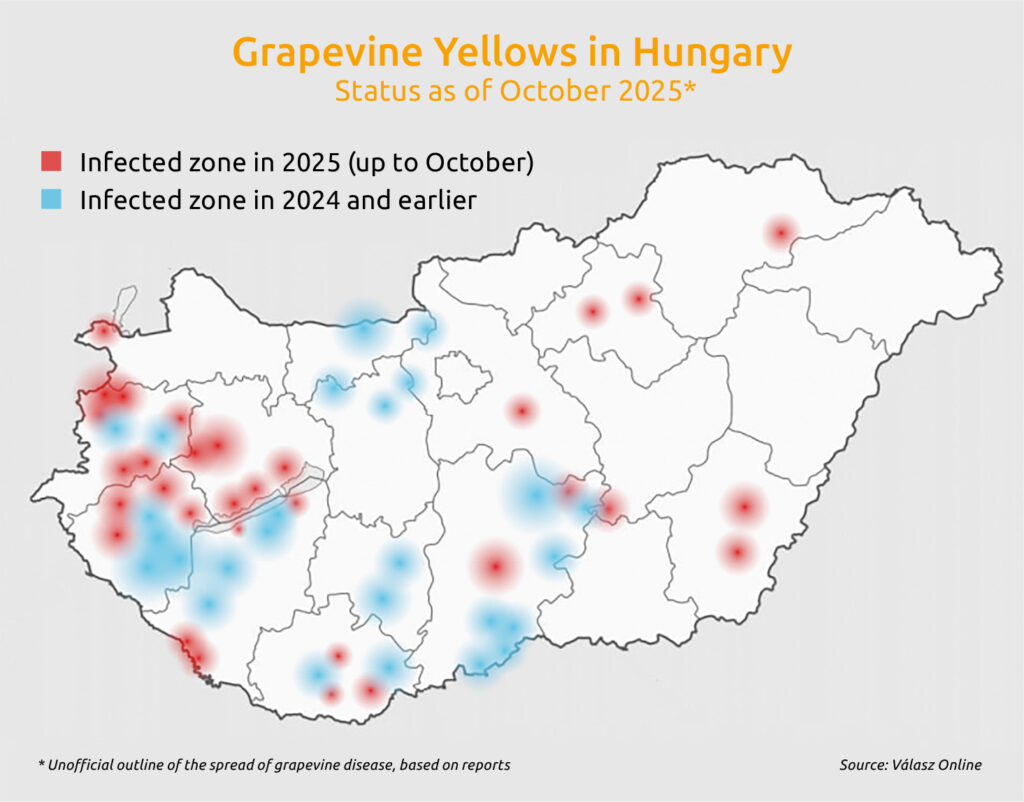
While the quality of Hungarian wine has improved exponentially in recent years, the industry is facing a seismic threat in the form of the Flavescence dorée grapevine disease. Also known as Grapevine Yellows, it leads to a severe reduction in yields before vines actually die. It is caused by a bacteria-like phytoplasma that inhabits the vine’s sap. The Budapest Business Journal spoke to Ákos Molnár, a member of the National Council of Wine Communities’ presidential board, about the threat it poses and what can be done to combat it. We also spoke about the challenges posed by climate change. Molnár is president of the Sopron Wine region, as well as a specialist in vine protection and vineyard management.
BBJ: How threatening do you consider Flavescence dorée to be in Hungary?
Ákos Molnár: Many people compare the disease to the phylloxera epidemic [which devastated European vineyards in the late 19th century]. Unfortunately, they are probably right, because if we do not take steps against the disease in a unified and decisive manner, significant vineyard areas may be destroyed, and, especially regarding Carpathian Basin grape varieties, serious damage could be suffered by producers and consumers alike.
BBJ: Why are Carpathian varieties particularly at threat?
ÁM: They are at great risk because most of them are found in small areas. If a disease wipes out such a small area, genetic diversity is greatly reduced and, in unfortunate cases, a species may even become extinct. This risk is particularly high in species collections, where there are only a few individuals of each species.
BBJ: How do you envisage Flavescence dorée’s impact in the coming years?
ÁM: We are not over the worst of it. Even with coordinated control efforts, the problem will remain with us forever and can at best only be managed. Even if we succeed in pushing the epidemic back, we will never be able to eliminate it completely. Given the course of the disease, the number of symptoms will likely continue to increase for another one to two years, even with effective control measures. Nevertheless, I am optimistic because in Western Europe, in France and Italy, where they have been living with this disease for decades, they have been able to control it effectively and have reduced the incidence of infections to a level below that which causes serious economic damage. They have also been able to keep it like that. With consistent and persistent effort, this opportunity is available to us as well.
BBJ: What can and is being done to combat it?
ÁM: The strategy for control is quite complex and rests on several pillars, all of which must be fulfilled for the defense to be effective. These are: ensuring healthy propagation material; continuous monitoring of vineyards and the removal of symptomatic vines; chemical plant protection measures against the disease-spreading vector (the American grapevine leafhopper); and the elimination of neglected vineyards and reservoir areas. If any one of these conditions is not met, the control efforts will, unfortunately, be ineffective.
It is important to emphasize that we all, from the producer community to the authorities, share responsibility to ensure that these processes are carried out in a coordinated manner, with appropriate professional expertise and without delay. We see that after some initial hesitation, in the second half of last year, both the interprofessional organizations and the Ministry of Agriculture placed sufficient emphasis on addressing the situation. By amending a number of regulations, they made the control process easier and are also supporting efforts to contain the epidemic with significant financial resources. At the same time, as in any epidemic situation, there are still many tasks to be addressed, both legal and economic. Nevertheless, we’re finding that all stakeholders are approaching these questions with sufficient openness and a constructive attitude.
BBJ: Has the cold winter helped the situation?
ÁM: Unfortunately, a colder winter than in recent years is offering grape growers hopes that lack a scientific basis. It has not been cold enough to significantly reduce the population of leafhoppers overwintering in the egg stage. However, a positive effect of the cold winter is that it will very likely cause the leafhoppers to hatch simultaneously, making it easier to determine the optimal timing of chemical plant protection measures.
BBJ: How are your members coping with climate change?
ÁM: Grape growing and winemaking are fundamentally tradition-oriented sectors, responding much more slowly [than other areas] to environmental or economic changes. As in other areas of life, adaptability is extremely important here as well, along with the availability of the knowledge required to adapt to change. In these areas, significant tasks lie ahead of us, as both research itself and the transfer of research results to producers pose serious challenges. Only in this way can we ensure that our producers are able to find positive responses to change. Financing these processes is an unavoidable issue because the rapid changes of recent times require swift interventions. This can only be supported through focused research and highly efficient knowledge transfer.
BBJ: How does it affect grape growing and production?
ÁM: From this perspective as well, the sector is facing major changes. The variety structure [the type of grapes planted] and cultivation technology will certainly undergo partial transformation. Several factors related to climate change will have a significant impact on the sector. The continual recurrence of hot, dry summers, along with the persistent occurrence of spring frosts, threatens both production security and the customary high quality. In the former case, grape growing using irrigation will become unavoidable in arid regions. This is particularly true for the Danube-Tisza Interfluve. On the other hand, with new practices in cultivation technology, there is an opportunity to reduce drought damage while preserving flavor and aroma compounds, as well as an optimal acid structure.
BBJ: Are some wine regions actually benefiting from climate change, while others suffer?
ÁM: With adequate adaptation, our northern wine-growing regions may well be among the beneficiaries of these changes; however, these processes pose serious challenges to our wine regions with dry, warm climates. In these matters, it will be our task to support producers with information and knowledge so that they can respond positively to these changes.
This article was first published in the Budapest Business Journal print issue of February 13, 2026.