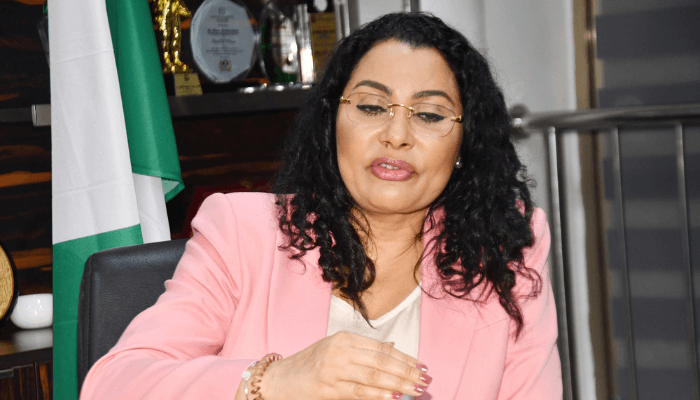
Doris Uzoka-Anite, the minister of state for finance has said that poor revenue generation was impacting the government ‘s ability to reduce the burden of debt servicing and catalyse needed growth to achieve national development.
The minister stated this while addressing the National Economic Council Conference in Abuja on Monday.
According to her, while the nation’s debt-to-GDP ratio remains manageable at approximately 36 percent, the cost of debt servicing represents a more pressing issue that must be addressed, as it absorbs a significant share of government revenue and limits its collective fiscal flexibility.
Read also: Access Bank’s bid for Bidvest Bank collapses as South African sale process restarts
This is as the government plans to spend over N15 trillion on debt servicing in 2026 budget, representing almost half of the N34.3 trillion revenue target.
Uzoka-Anite noted that the bold reforms by President Tinubu has significantly expanded the nation’s fiscal space, increased revenues available to the Federal Government and the States, and reduced a major source of economic distortion.
“Our fiscal health shows discipline but also constraint. Our public debt stock stands at N152 trillion, a figure which importantly reflects greater transparency through the formal recognition of historical liabilities, not merely new borrowing.
“The debt-to-GDP ratio remains manageable at approximately 36 percent, well within international benchmarks such as the IMF’s 55-70 peecent threshold for emerging markets.
“However, the more pressing pressure, as many Governors here will attest, is the cost of servicing that debt, which absorbs a significant share of government revenue and limits our collective fiscal flexibility. Yet revenue growth continues to elude us to reduce the burden of debt servicing and catalyse needed growth to achieve our collective ambition,” the minister said.
She explained that the country is facing a revenue and volatility challenge, adding that unpredictable revenues make planning and service delivery difficult at every level of government.
To meaningfully reduce poverty and unemployment, Uzoka-Anite said that Nigeria must sustain growth rates of 6-7 percent, well above population growth.
She explained that the Central Bank of Nigeria (CBN) and the Ministry of Finance share a growth projection of 4.49 percent for 2026, rising to 4.68 percent, with inflation expected to ease gradually, with a target to bring it below 13 percent by the end of 2026.
For her, this outlook shows progress, but it also confirms that acceleration must be engineered. She added that the growth rate required to achieve a $1 trillion economy is at the minimum 10 percent in 10 years. “This is different from what I mentioned earlier, which is 6-7 percent to impact the level of poverty in the country.”
The minister, speaking further said that to achieve this outlook, there must be a necessary fundamental shift in the nation’s economic model. “Our role must evolve decisively from being the primary spender to being an enabler of investments that de-risk and unlock private capital investment.
“The government alone cannot finance the transformation we seek. As validated by international investors, strategic public de-risking can unlock private capital at a multiplier of 3 to 5 times the public investment in key infrastructure.
Read also: Nigerian lawmakers urge removal of electricity subsidy to boost revenue
“By strategically leveraging limited funds to de-risk priority projects in sectors such as agriculture, manufacturing, energy, digital infrastructure, transport, and logistics, every Naira of public investment can unlock multiple Naira and dollars of private capital, creating a virtuous cycle of growth, millions of jobs, and future tax revenues.
“Therefore, investment budgeting becomes an essential component in the growth trajectory of our nation. Our approach to budgeting must go beyond a focus on revenue and expenditure to one that emphasises wealth creation.
“Because of the importance of this concept to national development, this year Mr. President mandated that investment budgeting be included in the budget design as the foundation for the growth we seek. This is another ground-breaking innovation by Mr. President to catalyse the $1T economy he promised Nigerians.,” she added.
